Macular Degeneration
Our outer appearance changes a lot as we age. We start to see wrinkles on our faces and age spots on our skin. But what a lot of people don’t realize is that there are a lot of changes happening inside of our bodies. Your eyes are no exception. As we age, we become more and more susceptible to a plethora of common conditions, one of them being age-related macular degeneration (AMD).
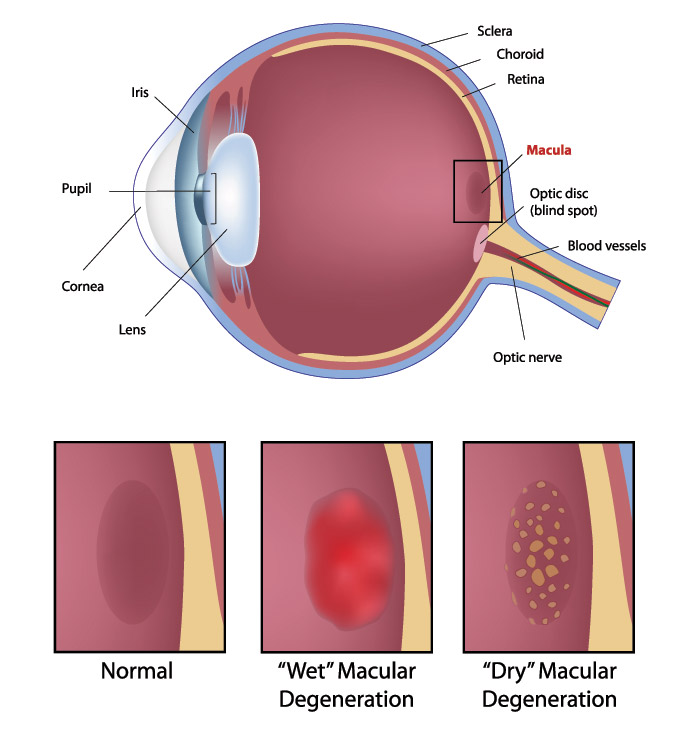
Diagram for Macular Degeneration
AMD is not necessarily a household name – many people have never heard of it until they are diagnosed. Here at Glaucoma and Cataract Consultants in Pittsburgh, we are dedicated to providing our patients So, what exactly is this common eye disease, who is at risk for it, and what can we do to treat it?
What is AMD?
Age-related macular degeneration is an eye disease that affects the macula. The macula is a tiny patch of light-sensitive tissue located in the middle of the retina. The macula is responsible for your central vision – everything you see directly in front of you.
There are two types of AMD:
- Dry AMD. Dry AMD makes up for about 80% of all macular degeneration cases. The cause is currently unknown, and this type tends to progress much more slowly. Currently, there is no cure for this type of AMD. Dry AMD occurs when yellowish fat deposits begin to form under the macula and retina, causing it to deteriorate over time. Dry AMD can cause vision loss.
- Wet AMD. Wet AMD makes up for about 10-15% of all AMD cases. Wet AMD causes tiny, abnormal blood vessels to grow underneath the retina and toward the macula. These blood vessels are weak and easily break, leaking fluid and blood, which damages the macula. Wet AMD can cause severe vision loss, and is treatable through multiple methods.
AMD Symptoms
AMD itself does not lead to complete blindness. Since the macula is only responsible for central vision, only central vision will be affected by AMD. Peripheral vision may still be intact.
Early-stage AMD does not present many symptoms, which is why it is important to attend regular eye examinations. The first symptoms patient’s notice is a gradual or sudden change in the quality of their vision. Straight lines may appear distorted.
Other symptoms include dark, blurry areas or whiteout in central vision, or a change in color perception.
Who is at Risk?
The cause of macular degeneration is not currently known, but there are a few known risk factors.
Age is the biggest risk for AMD. Other risks include:
- Smoking. Smoking doubles the risk of AMD.
- Race. AMD is more likely to occur in Caucasian people than African-Americans or Hispanics/Latinos.
- Family History. People with a family history of AMD are more likely to develop it themselves.
AMD Treatments
Early AMD has no treatments. Doctors may suggest lifestyle changes such as healthy diet, more exercise, avoiding smoking or AREDS II vitamins. This may help prevent AMD progression and vision loss. For intermediate to late AMD, a supplement regimen may be helpful in slowing progression of AMD.
An advanced form of wet AMD, called advanced neovascular AMD, can be treated through several methods. These methods include anti-VEGF injections, photodynamic therapy, and laser surgery. These treatments are aimed at stopping the growth of new, abnormal blood vessels on the retina and macula.
Have you or a loved one been diagnosed with AMD? Here at Glaucoma and Cataract Consultants, our AMD specialists are here to help every step of the way. Contact our Pittsburgh, Mt. Pleasant or Charleroi offices to schedule your AMD consultation today!